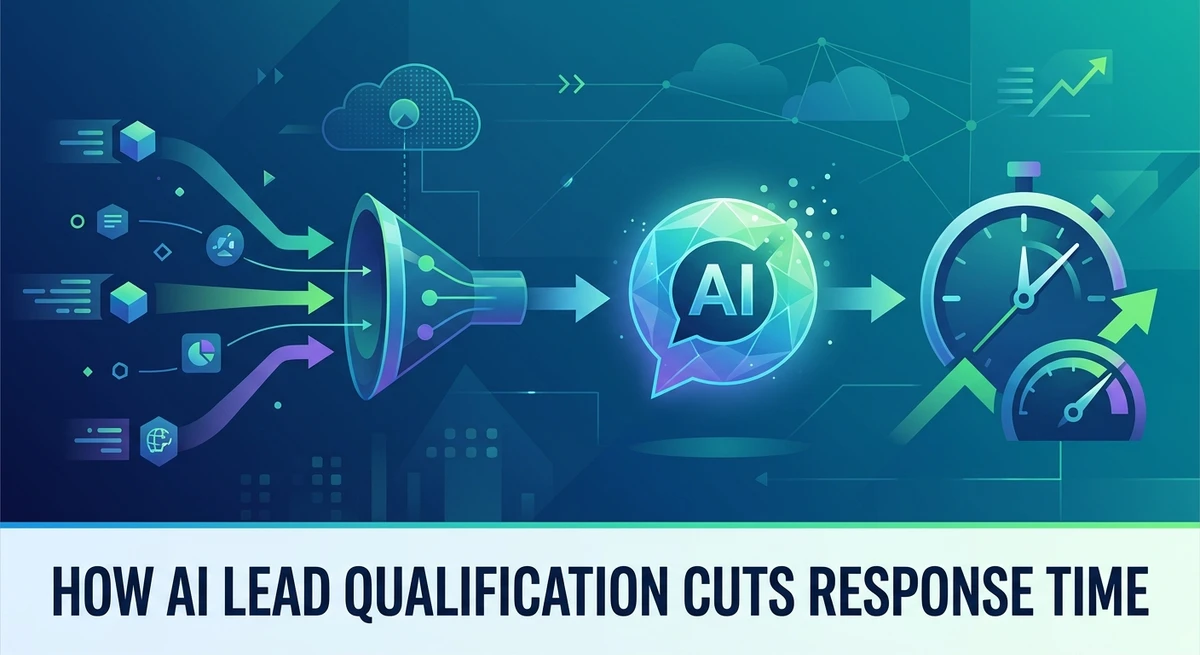
I used to think the bottleneck was lead volume, but what is ai lead qualification really solving is response time: the gap between a visitor asking a question and your team answering it. For agencies and sales teams, that gap is where good leads disappear.
AI lead qualification is a real-time system that talks to website visitors, asks the right questions, scores intent, and routes qualified prospects into your workflow without waiting for a rep. In our work, that means a visitor can be identified, categorized, and handed off 24/7 while the page is still open.
What most teams miss: manual forms collect data, but they don't create momentum. The first reply often decides whether a visitor becomes a meeting or a bounce.
Formula: Qualified Pipeline = Traffic x Intent Capture x Response Speed.
Flow chain: Visitor intent → conversational questions → lead score → workflow action → booked handoff.
What AI lead qualification actually does
The short answer is that it replaces static forms with a live conversation. Instead of asking every visitor to fill out the same 7 fields, the system adapts the flow based on what the person says, what page they're on, and how quickly they engage. That's why ai lead qualification vs manual filtering usually wins on speed, not just convenience.
- It identifies intent early, often before a visitor reaches your contact form.
- It asks fewer but better questions, which reduces drop-off on high-friction pages.
- It captures context automatically, so your team sees industry, budget, timeline, and use case in one place.
- It keeps working after hours, which matters when 24/7 traffic is coming from paid ads or referral clicks.
For example, if someone lands on a pricing page at 9:40 p.m. and says they need implementation in 30 days, the agent can qualify that lead immediately and send it into the sales queue before your competitor replies the next morning. That difference is measurable in minutes, not theory.
How does real-time lead qualification work?
Real-time qualification works because the agent reacts while the buying signal is still fresh. I treat it as a four-step system: detect, ask, score, act. That sequence is the reason website lead capture automation benefits show up so quickly when the site already has traffic but no one is watching it closely.
- Detect the visitor's context from page behavior, referral source, and message content.
- Ask one relevant question at a time, instead of dumping a long form on the screen.
- Score the lead using rules tied to your sales criteria, such as company size, timeline, or service fit.
- Trigger the next action, such as booking a call, notifying Slack, or pushing data into HubSpot.
A practical example: a small agency may want enterprise prospects routed to sales immediately, while smaller inquiries get nurtured. The system can do both without a rep deciding in real time. That matters because the best conversational ai for lead capture is not the one that chats the most, it's the one that makes the right operational decision fast.
Answer block: Real-time lead qualification is a conversation layer that replaces static lead forms with adaptive screening. It watches how a visitor behaves, asks targeted questions, and routes the result into your CRM or inbox while the lead is still active. In a service business, that often means a visitor who would have bounced after a long form instead gets a short, guided exchange that ends with a meeting request or a clean handoff. The difference is not cosmetic. If your sales team responds in 15 minutes instead of 15 hours, you're working with a warmer prospect, clearer context, and far less follow-up friction. That's why teams use it to speed up sales without adding headcount.
Why is automated lead capture better than manual forms?
Automated capture beats manual forms when the cost of waiting is higher than the cost of asking. That's most obvious in B2B service sales, where a visitor may compare three vendors in one session and only book with the company that answers first. We see the biggest gap on mobile traffic, where long forms lose users fast.
According to HubSpot's marketing statistics, speed and response quality both shape conversion behavior, and that matches what we see in live qualification work: the shorter the delay, the higher the chance of contact. If you want a broader benchmark on user patience, Google's research on mobile page speed shows that a slower experience increases abandonment risk fast.
- Manual forms wait for effort, which filters out impatient buyers and unqualified ones alike.
- Automated conversations reduce friction by making the exchange feel like help, not paperwork.
- Conditional routing improves fit because different visitors need different questions.
- After-hours capture keeps demand warm, especially if paid media is driving traffic outside business hours.
Here is the part most teams overlook: a form can collect data, but it can't recover hesitation in the moment. A live agent can. That's the real reason automated capture often outperforms manual collection on websites with steady inbound demand.
What does lead qualification cost in practice?
The practical answer is that the real time lead qualification cost is usually lower than the cost of lost leads, missed after-hours inquiries, and rep time spent sorting unfit contacts. For a small team, even one qualified deal recovered per month can justify the system if the sales cycle is worth four figures or more.
Answer block: The cost question should be framed as cost per qualified opportunity, not cost per chatbot. A static contact form looks cheap until you count the leads it fails to convert, the hours your team spends triaging junk, and the revenue lost when an overnight visitor never gets a reply. In our projects, the economic win usually comes from three places: fewer manual handoffs, faster routing, and better lead completeness. If a rep spends 20 minutes a day cleaning up form submissions, that's about 100 minutes a week. Over a month, that's more than 6 hours of admin time recovered. The bigger gain is conversion speed, because a lead handled in real time is much more likely to stay engaged than one that waits until morning.
- Count the hours spent triaging leads each week.
- Estimate the value of one qualified meeting in your pipeline.
- Compare that value to the number of missed inquiries you get after hours or on high-traffic pages.
That simple math is usually enough to answer whether automation makes sense before you even model uplift.
Which teams get the biggest lift?
The strongest gains usually show up in agencies, B2B service firms, and teams running paid traffic to high-intent pages. I say that because those teams already pay for attention, but they often lose it at the handoff. A live conversational agent closes that gap by qualifying visitors while the intent is still fresh.
- Agencies can segment prospects by budget, service type, and timeline before a strategist gets involved.
- Sales teams can prioritize hot leads without reading every submission manually.
- Founders can keep lead capture alive overnight without hiring a night shift.
- Marketing teams can see which pages produce qualified conversations, not just raw form fills.
We built for that exact use case: websites that already attract traffic, but need a better way to turn that traffic into conversations. A visitor who gets the right question on the first screen behaves very differently from one who lands on a generic form.
Formula: Revenue Impact = Qualified Meetings x Close Rate x Average Deal Value.
How to qualify leads without slowing the page down
The answer is to keep the conversation short, relevant, and conditional. If the agent asks five unnecessary questions before delivering value, it becomes the same friction problem as a form. The goal is not more interaction, it's better filtration.
- Start with one qualifying question tied to intent, such as service need or project timeline.
- Branch only when needed, so high-intent visitors move faster than low-fit ones.
- Send the result somewhere useful, like HubSpot, Slack, or your CRM, within seconds.
- Review conversation drop-off weekly and trim any question that doesn't improve routing quality.
In practice, I like to cap the first exchange at 2 to 3 questions before a handoff decision. That keeps the experience light while still gathering enough detail to act on. It also makes the system easier to measure, because every extra question has a visible cost.
Answer block: The best way to qualify leads without slowing the page is to treat every question like a pricing decision. If a question doesn't improve routing, scoring, or follow-up, it doesn't belong in the first exchange. That rule keeps the experience fast enough for mobile visitors and specific enough for sales. A clean setup usually starts with one trigger question, one qualifying branch, and one action, such as booking, notifying, or storing the record in a CRM. For example, a visitor who needs implementation in under 30 days can go straight to sales, while a low-fit inquiry gets routed into nurture. That structure reduces wasted rep time and preserves the momentum that made the visitor respond in the first place.
Questions people ask about AI qualification
The most useful questions are usually the ones teams ask after the first demo: what it can replace, what it can't, and how fast it pays off. Those answers tell you whether the system solves a workflow problem or just adds another layer of software.
Can AI replace a salesperson's first qualification call?
It can replace the first screening call when the goal is to collect fit signals, route the lead, and book the right next step. It won't replace a complex discovery conversation. In practice, that's a good trade: the AI handles repetitive triage, and the salesperson starts with context instead of blank notes. That usually shortens the path from inquiry to meeting.
How fast should an AI agent respond on a website?
It should respond instantly, because even a short delay changes behavior. If the visitor has already asked a question or landed on a pricing page, the conversation should begin in the same session. The whole point of automation is to keep the lead warm while intent is still visible.
What makes one conversational agent better than another?
The better agent is the one that qualifies accurately, routes cleanly, and stays aligned with your sales criteria. Conversation quality matters, but operational output matters more. If the tool captures names but misses budget, timeline, or service fit, it creates noise instead of pipeline.
The common pattern across these questions is simple: teams don't need more chatter, they need a system that turns intent into a usable next step. That's where we spend most of our time at Rioform, building an autonomous agent that listens, qualifies, and acts without asking your team to babysit every lead.