I used to think the problem was traffic. It wasn’t. The real leak was how to automate lead capture without making every visitor wait for a human to respond, and the gap showed up in the first 90 seconds: a hot lead would land, ask one sharp question, then disappear before anyone on the team replied.
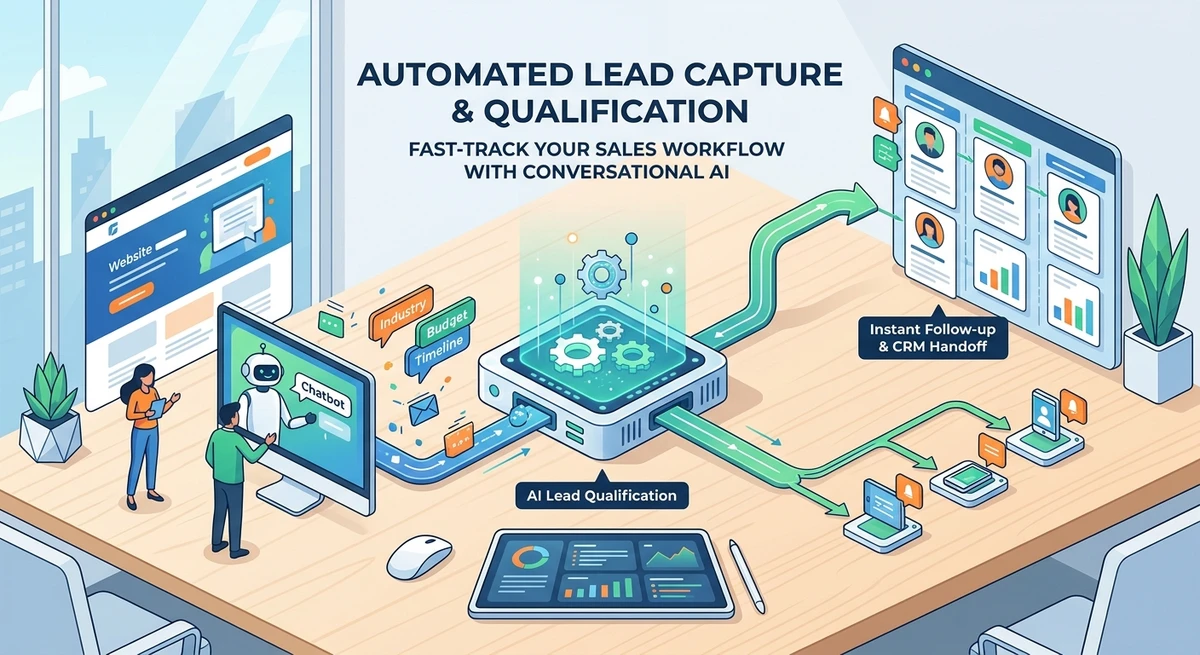
For teams asking how to qualify leads faster, the answer is usually not more forms or more SDR hours. It’s an AI lead qualification layer that greets visitors, asks better questions than a static form, and routes only the serious ones into your workflow. In this article, I’ll show the workflow we use, where manual handoff breaks, and why website lead capture automation benefits usually show up in speed first, then conversion rate.
Definition: What is AI lead qualification? It’s the use of a conversational system to identify intent, fit, and urgency while the visitor is still on the site, then pass the result into your CRM or sales process immediately.
Why manual capture loses leads so fast
Manual lead capture fails at the exact moment the buyer is most active. A visitor is interested, but not committed, and every extra minute between question and answer reduces the odds that they’ll stay. We’ve seen this in agency funnels, SaaS demos, and service businesses where a form submission sits in a queue while the visitor keeps browsing other tabs.
- Delay kills intent, especially on pricing, demo, and contact pages.
- Static forms collect data, but they don’t adapt to the visitor’s behavior.
- Teams often qualify after the fact, which means they spend time on low-fit leads.
- Hot traffic gets the same treatment as cold traffic, which wastes the highest-value sessions.
According to HubSpot’s marketing research, speed to lead still shapes conversion outcomes because buyers expect faster response than they did even a few years ago. Our rule is simple: if the site can’t respond in real time, it’s already behind the visitor’s decision clock.
Formula one: Lead Capture Value = Traffic x Response Speed x Qualification Accuracy. If any one of those is weak, the whole system underperforms.
What does real-time qualification actually do?
Real-time qualification changes the job from collecting names to interpreting intent. The agent asks a first question, reads the reply, then adjusts the next prompt based on what the visitor says and does. That means someone asking about enterprise pricing gets a very different path than someone who just wants a brochure or a quick contact form.
In practice, the system scores fit while the conversation is still open. A visitor can be tagged as high intent, routed to sales, or sent to a nurture path before they leave the page.
This is why ai lead qualification vs manual qualification is not just a tooling debate. Manual processes wait for a rep to interpret intent later; conversational systems interpret intent at the point of contact. On a busy site, that difference can cut hours of follow-up waste every week and reduce the number of unworked leads slipping through after business hours.
One pattern we see often: a paid campaign drives a spike of traffic at 8:30 p.m., the form fills, and nothing happens until morning. By then, the buyer has already booked a competitor. Real-time qualification closes that timing gap.
How do you automate lead capture without adding friction?
Best conversational ai for lead capture works because it feels like a guided exchange, not a gate. The goal isn’t to ask five hard questions upfront. The goal is to ask one useful question, respond to the answer, and keep the interaction moving toward a qualification outcome.
We use a three-part flow: greet, qualify, route. That’s it. If you try to make the first touch do everything, you create friction and lower completion rates.
- Start with a context-based opener tied to the page the visitor is on.
- Ask one qualification question that maps to intent, budget, timeline, or use case.
- Branch based on the answer, then send the result to the right workflow automatically.
Formula two: Response Time + Relevance + Low Friction = More Qualified Conversations. I’ve found that the fastest gains come from removing one unnecessary field, not from making the script longer.
A practical example: on a services site, the agent can ask, “Are you comparing providers this week, or just gathering options?” That single question separates research traffic from buying traffic without making anyone feel screened.
What should an AI lead qualification flow include?
We build qualification flows around behavior, not just contact data. That matters because company name and email don’t tell you whether the lead is ready to buy. A visitor who clicks pricing, returns to the page, and asks about setup is a different lead from someone who opened the site from a referral and immediately asked for a PDF.
Key takeaway: the best workflow captures intent signals before it asks for identity, because identity alone doesn’t tell you whether sales should act now.
- Page context, such as pricing, demo, or contact intent.
- Conversation branches based on short answers, not long forms.
- Lead scoring that can mark urgency, fit, and source in real time.
- Automatic routing to CRM, email, Slack, or a scheduling step.
- Fallback handling when the visitor is uncertain or needs education.
Here’s the flow chain we actually care about: Visitor behavior → conversation → qualification score → routing → follow-up. If the chain breaks anywhere, the site is back to being a static form with better branding.
A strong flow also gives you a clean handoff. Sales doesn’t need to read a transcript from scratch, they need the summary, the score, and the next best action.
Why do most teams get automated capture wrong?
Most teams over-ask too early. They copy the old form logic into a chat window, then wonder why completion drops. The visitor isn’t against sharing information, they’re against effort that doesn’t feel useful. When the first message asks for name, email, company size, and budget, the chat dies fast.
Answer block: Automated lead capture works best when it behaves like a skilled rep, not a database form. A good rep starts with context, listens for buying signals, and adjusts the next question based on the answer. That’s the model we use. If a visitor lands on a pricing page, we don’t start with a generic greeting. We start with the reason they’re likely there, then we ask one question that helps us judge whether they need sales now, later, or not at all. In most cases, that approach lifts qualified conversations because it feels specific and saves the visitor time. The point isn’t to collect more data, it’s to collect the right data while the intent is still warm.
Common mistake: treating ai lead qualifying software like a replacement for the sales team. It isn’t. It’s the first filter, the first responder, and the first routing layer. Once that’s clear, the workflow gets cleaner immediately.
For a useful benchmark, the NIST AI resources are a solid reference for responsible system design and evaluation, especially when you want to think clearly about reliability and traceability.
How much does real-time lead qualification cost?
Cost depends on traffic volume, routing complexity, and how many systems the agent has to touch. But the bigger cost question is not monthly software spend, it’s the cost of delay. If one qualified deal is worth $8,000 and you lose two a month because no one replied fast enough, the missed revenue dwarfs a modest automation budget.
Answer block: Real time lead qualification cost should be judged against the labor it replaces and the revenue it protects. A manual team might spend hours each week reading form fills, sorting duplicates, and chasing low-intent submissions. An automated system shifts that work into the conversation itself. In a small pipeline, that can save a founder or SDR team several hours a week. In a larger pipeline, it can reduce first-response lag from hours to seconds, which is where the financial payoff shows up. The right comparison is not software cost versus free forms. It’s software cost versus lost speed, wasted rep time, and the deals that never got a fair shot because nobody answered while the buyer was still paying attention.
- Low volume sites usually care most about saving founder time.
- Mid-market teams care about routing accuracy and CRM hygiene.
- High-traffic sites care about qualifying fast enough to protect conversion rate.
The simplest way to judge cost is this: if automation helps recover even one extra qualified deal a month, it usually pays for itself faster than a human review queue ever will.
How we measure whether it’s working
We don’t measure this with vanity metrics. A chat that gets clicks but no qualified handoff is just a nicer form. The real scorecard is whether the system shortens time to qualification and improves the quality of what sales receives.
- Track first response time from page load to first meaningful interaction.
- Measure qualification rate, not just total conversation volume.
- Review handoff quality, including completeness of context and routing accuracy.
- Compare booked meetings, not just captured leads, over a 30-day window.
Good signal: more of the right leads reach sales faster, and fewer irrelevant ones waste rep time. That’s the outcome we care about.
A concrete example: if a site gets 1,000 visits a month and only 4% convert, a better qualification layer may not change every session. But if it turns 10 additional high-intent visitors into immediate conversations, the downstream effect is easy to see in the pipeline.
Why does this approach hold up over time?
Because the system gets better at the exact point where manual workflows get tired. Human teams drift. They respond slower on busy days, miss after-hours traffic, and qualify inconsistently when inbox volume spikes. A conversational agent doesn’t solve every sales problem, but it does make the first response reliable.
Here’s the practical difference: manual lead capture depends on someone remembering to act, while automated capture depends on a workflow that acts every time.
If you want a durable setup, keep the agent focused on intent, keep the handoff clean, and keep the scoring simple enough that sales trusts it. That combination is what turns an AI chat into a real qualification system instead of a novelty widget.
When we built Rioform, that was the problem we kept seeing: leads weren’t disappearing because companies lacked traffic, they were disappearing because the site couldn’t listen and respond fast enough. That’s the gap we built to close.