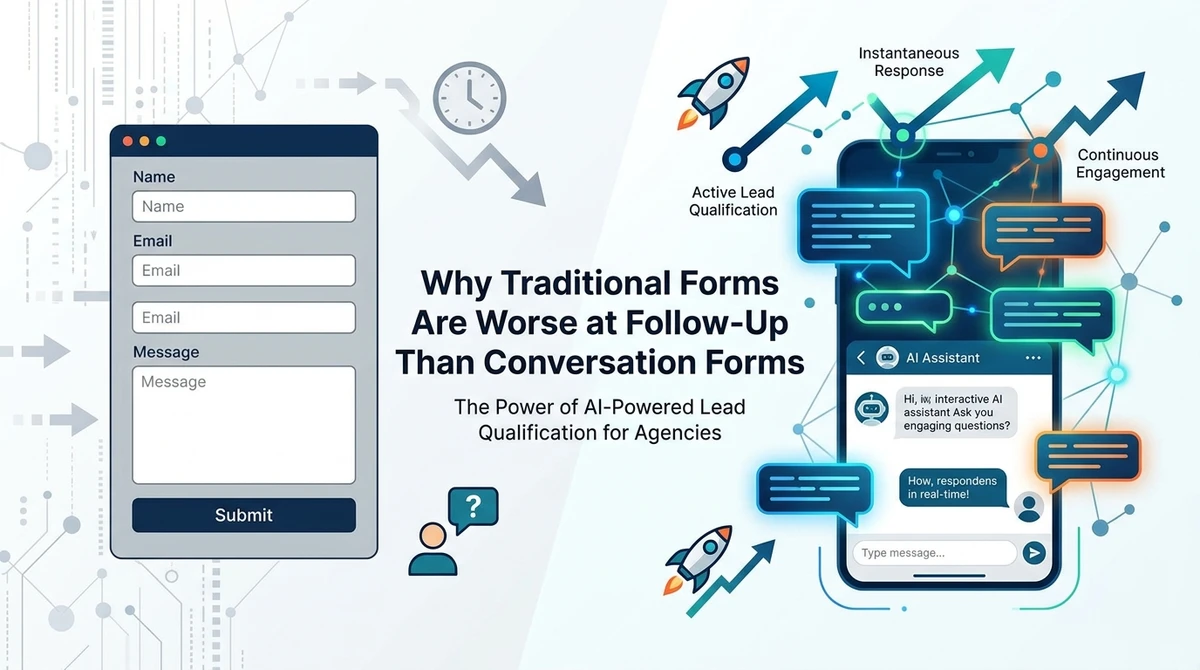
I’ve watched too many good leads die in the same place: a plain form with a polite thank-you page. The traffic was there. The offer was solid. What broke was follow up. By the time someone on the team got around to the submission, the prospect had already moved on, booked with someone else, or forgotten why they reached out in the first place.
That’s why I pay so much attention to the conversation form now. It changes the moment of intent from a static handoff into a live exchange. And for agencies, that shift matters more than most teams realize.
Traditional forms look efficient. They usually aren’t.
We got used to thinking of forms as a capture tool. Fill in the fields, hit submit, and the lead is yours. Clean. Simple. Easy to measure.
But that clean handoff hides the real problem. A traditional form collects data. It doesn’t qualify, reassure, or respond. It can’t ask a follow-up question when the answer is vague. It can’t sense hesitation. It can’t route a hot lead differently from a curious one.
So the form does its job, and then the work starts. That’s where the friction lives.
In agency lead gen, that friction shows up fast:
- People submit with missing context
- Sales teams chase low-intent inquiries
- Good leads cool off before anyone replies
- Follow-up becomes a human bottleneck
I’ve seen teams celebrate form fills while ignoring what happens next. That’s a dangerous way to run demand capture. The real metric isn’t submissions. It’s how many of those submissions turn into real conversations.
Lead capture without qualification is just inbox creation.
The pain point isn’t lead volume. It’s lead timing.
Most teams don’t lose because they get too few leads. They lose because they can’t act fast enough. The first response window is brutal. When a prospect is ready, they’re ready now, not after a queue, a spreadsheet, or a Monday morning review.
We’ve all seen the pattern. Someone fills out a form at 4:47 p.m. If the response lands hours later, the urgency is gone. Maybe they found another agency. Maybe they got distracted. Maybe they just decided the process felt too cold.
That’s why follow up is such an expensive blind spot. A delay of even minutes can change the outcome. In practice, this looks like a simple equation:
Lead Conversion = Intent x Response Speed
When response speed drops, conversion usually follows. Not because the lead was bad, but because the window closed.
One of the more useful signals I’ve seen lately came from a broader AI agent conversation on X. The common thread wasn’t hype, it was restraint: real agents still need to handle edge cases, context, and handoff logic if they’re going to work in the real world. That maps directly to lead follow-up. You don’t need a flashy demo. You need a system that can actually respond well when a lead shows up.
That’s the part most forms never touch.
A conversation form does the qualification while the lead is still warm.
This is where the model changes. A conversation form doesn’t ask for everything up front and hope for the best. It asks one question, then uses the answer to decide the next one. It feels closer to a live intake call than a static web form.
That shift matters because it matches how people actually share information. Most prospects won’t fill out a long form with precision on the first pass. They’ll answer if the interaction feels natural. They’ll give more if the questions make sense. They’ll stay engaged if the experience feels personal instead of mechanical.
We’ve found that the best version of this is not “more fields.” It’s better sequencing.
Keyword → Intent → Content → Publish → Improve
That same chain applies to qualification logic too:
- Ask the easiest question first
- Use the answer to shape the next prompt
- Collect the minimum data needed to qualify
- Route the lead based on fit and urgency
- Trigger follow up while interest is still active
That’s the difference between a form and a conversation form. One collects. The other progresses.
The best conversation forms feel less like paperwork and more like momentum.
Why agencies care more than anyone else
Agencies live and die on response quality. A missed lead isn’t just a missed opportunity, it’s wasted ad spend, wasted traffic, and a client who starts asking hard questions. If you’re running campaigns for other businesses, you don’t get credit for “good traffic” when the pipeline stays thin.
That’s why the agency use case is so compelling. A conversation form can sit at the front of the funnel and do three jobs at once:
- Capture the lead
- Qualify the lead
- Prepare the lead for the next action
That last part gets ignored too often. Preparation matters. If the lead arrives in the CRM with the right context, the sales team doesn’t start from zero. They know what the visitor wants, where they came from, and how serious they are.
I’ve seen the math work out in a very simple way:
Fewer wasted leads + faster follow up = better lead gen economics
That’s not a theory. It’s what happens when the first touchpoint does real work instead of acting like a mailbox.
The real advantage is consistency, not novelty
People hear “AI” and assume the point is novelty. It isn’t. The point is consistency under pressure. A human team can do excellent follow up, but not all the time, not instantly, and not at scale without strain.
A conversation form gives you the same first response every time. It doesn’t forget. It doesn’t get busy. It doesn’t wait until tomorrow. That matters because lead conversion is often decided by small things:
- Did someone answer quickly?
- Did the lead feel understood?
- Did the process ask for the right information at the right time?
- Did the next step feel obvious?
When those pieces line up, conversion gets easier. When they don’t, even strong campaigns can underperform.
I think about it like this:
Speed + Relevance + Routing = Better Follow Up
That’s the formula traditional forms struggle to deliver on their own.
What a good conversation form actually changes
The best outcome is not just more submissions. It’s better-quality conversations entering the pipeline with less manual effort.
In practice, that means:
- Leads get acknowledged immediately
- Questions feel contextual, not random
- Low-fit visitors can be filtered early
- High-intent leads can be routed faster
- Follow up happens while motivation is still high
That’s a different operating model. Your team stops treating every inquiry the same way. The system starts doing the sorting before a person has to.
And that’s exactly why I think conversation form is becoming the better default for agencies that care about lead conversion. Not because it sounds more advanced. Because it does the unglamorous work that actually moves revenue.
At Rioform, this is the problem we build for every day, an AI agent that qualifies leads in real time and handles the follow-up work that usually gets lost between form fill and first reply.
FAQ
What makes a conversation form different from a regular form?
A regular form asks for information all at once and stops there. A conversation form asks questions step by step, reacts to the answers, and keeps the lead engaged while it qualifies fit.
Do conversation forms really improve follow up?
Yes, because they don’t wait for a human to start the interaction. They can respond immediately, collect context, and pass the right details into your workflow so follow up happens faster and with more relevance.
Are conversation forms better for lead gen than standard forms?
For a lot of agency funnels, yes. They tend to reduce abandonment, improve completion quality, and give you better data before sales ever gets involved.
Will a conversation form replace my sales team?
No. It takes the repetitive intake work off their plate. Your team still handles the actual selling, but they start with cleaner, warmer leads.
What should I measure first?
Start with response time, completion rate, and how many leads make it from inquiry to real conversation. Those three numbers tell you more than raw form submissions ever will.