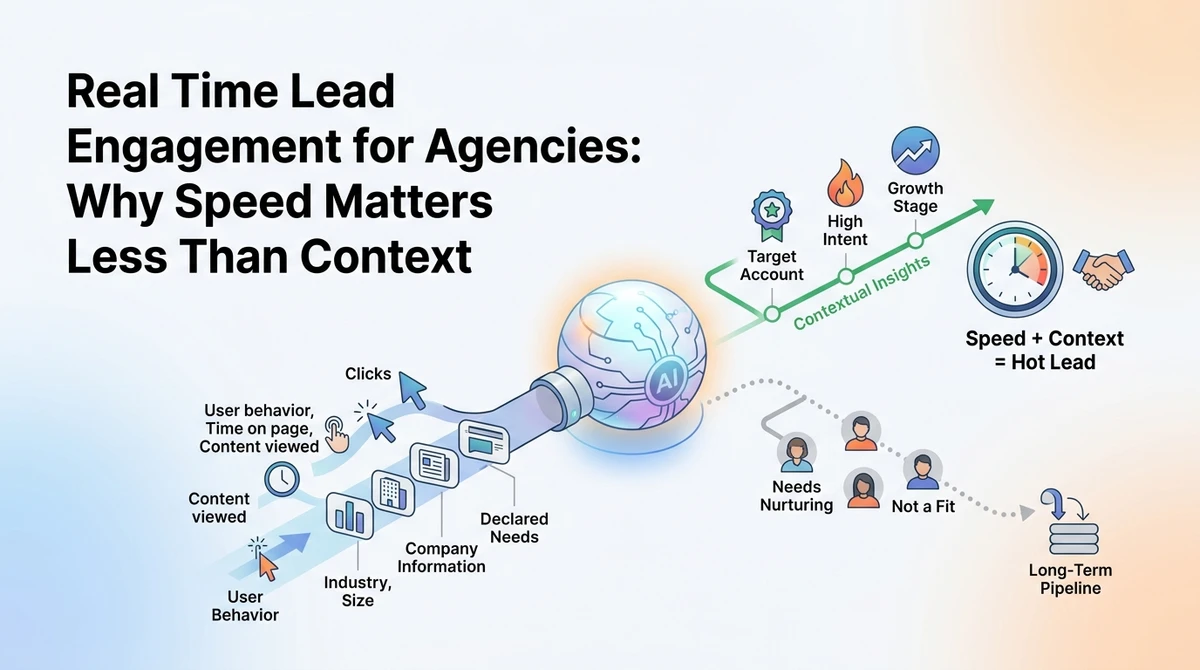
I used to think the fastest agency won the lead. That was true, until we started watching what happened after the first reply. The leads that converted weren’t always the ones contacted first. They were the ones that felt understood within the first minute.
That changed how we think about real time lead engagement. Speed still matters, but speed without context just creates another generic touchpoint. And generic touchpoints are where good leads go quiet.
We see this pattern constantly in agency funnels. A visitor lands, hesitates for a few seconds, and leaves because nobody answered the question behind the click. Not the page question. The real one.
Why fast follow-up alone keeps failing
Most agencies already know the old rule: respond fast or lose the lead. The problem is that rule is incomplete. Fast follow-up helps, but it doesn’t solve the bigger issue, which is whether the lead feels like anyone is actually paying attention.
Here’s the formula we keep in mind:
Lead Conversion = Speed + Relevance + Timing
If one of those pieces is missing, conversion drops. A five-minute response to the wrong message still feels off. A one-minute response that asks the right question feels like momentum.
I’ve seen teams build impressive response systems that still underperform because every reply starts the same way. “Thanks for reaching out” sounds polite, but it doesn’t move the conversation forward. It doesn’t qualify. It doesn’t reassure. It just occupies space.
The better question is simple: what happens between the first click and the first useful exchange?
- Does the visitor get a response that matches their intent?
- Do we collect the details we actually need to qualify them?
- Do we hand off the right lead to the right person without friction?
If the answer is no, the funnel is leaking before the sales team even sees it.
What a good AI agent does in the first 60 seconds
This is where conversational ai starts to matter for agencies. A good ai agent doesn’t just greet the visitor. It starts a qualified exchange that feels natural, short, and useful.
We’ve found that the first minute is where most of the value lives. Not because the conversation needs to be long, but because the conversation needs to be precise.
A solid real-time interaction usually does four things:
- Asks one clear question tied to intent
- Adapts the next question based on the answer
- Captures contact details without making the visitor work
- Routes the lead or triggers follow-up automatically
That sequence matters. Keyword → Intent → Qualification → Routing → Follow-up
When that chain works, the website stops acting like a brochure and starts acting like a live intake channel. That’s a very different job.
I’ve watched agencies cut lead drop-off just by replacing a static form with a conversational flow that feels more like a conversation and less like paperwork. People answer more when the next question makes sense. It’s that plain.
Why personalization changes the quality of the lead, not just the volume
There’s a mistake I see a lot: teams treat personalization like a branding layer. Nice to have, but not operational. That misses the point. In lead qualification, personalization changes what you learn and how quickly you learn it.
When a visitor gets a generic experience, they give generic answers. When the interaction reflects their service type, budget range, timeline, or agency fit, the quality of the response changes immediately.
That’s the real job of real time lead engagement. Not just to capture a name, but to shape the conversation around the lead’s intent.
We usually think about it like this:
Better Questioning = Better Qualification = Better Sales Time
That’s not theory. It’s workflow.
For example, an agency lead asking about paid search management shouldn’t get the same path as someone asking about web design retainers. Those leads need different questions, different scoring logic, and often different handoff rules. The more the experience mirrors the actual business, the less cleanup the sales team has to do later.
And that cleanup is expensive. Every unqualified intro call costs time, attention, and sometimes morale. Nobody loves sitting through five calls to find one real opportunity.
What we look for before we automate anything
Automation only works when the underlying logic is sound. Otherwise, you just make bad processes faster.
Before we put an ai agent in front of a lead flow, we look at three things:
- Intent signals, what should the agent pick up from the page or entry point?
- Qualification rules, what makes a lead worth passing along?
- Action paths, what should happen after the conversation ends?
If those three pieces aren’t clear, the AI can’t help much. It can still talk, but talking is not the same as qualifying.
We’ve learned to keep the first implementation tight. A narrow flow beats a clever one. One good path that captures high-intent leads is more valuable than five branching paths nobody finishes.
That restraint matters because agencies often try to solve every intake problem at once. They want lead capture, qualification, scheduling, routing, CRM updates, and follow-up in one release. I get the impulse. It usually creates friction where there should be momentum.
The better move is to start with the highest-value path, prove it, then expand.
The formula we use when evaluating lead engagement
We’ve built a simple scoring lens for this work:
Qualified Lead Score = Intent Fit + Response Fit + Sales Readiness
It sounds basic, and that’s the point. The best systems aren’t complicated for the sake of looking advanced. They make the next action obvious.
Here’s how that plays out in practice:
- Intent fit tells us whether the visitor matches the offer
- Response fit tells us whether the conversation is moving in the right direction
- Sales readiness tells us whether it should go to a human now or later
Once you have that, you stop treating all leads the same. That alone changes how agencies prioritize follow-up.
I’ve seen teams waste their best hours on leads that were never going to move. I’ve also seen smaller teams outperform larger ones because they only touched the leads worth touching. That difference usually comes down to how well the initial conversation separates signal from noise.
What changes after the system is live
The first thing people notice is fewer abandoned leads. The second thing is that the sales team starts trusting the inbound flow again.
That trust matters more than people admit. If the team believes the leads are junk, they work them differently. They rush. They skim. They delay. The whole machine slows down.
When real-time qualification is working, the behavior changes:
- Visitors get answers while they’re still engaged
- High-intent leads move forward without waiting on a human reply
- Sales teams spend less time sorting and more time selling
- Follow-up becomes cleaner because the context is already there
That last point is easy to miss. Good qualification doesn’t just help the first touch. It improves every touch after it.
And once the team sees that, the conversation about automation changes. It stops being about replacing people. It becomes about protecting human time for the moments that actually need it.
That’s usually the turning point.
FAQ
How is real time lead engagement different from a regular chatbot?
Most chatbots wait for prompts and then answer. Real time lead engagement starts with qualification logic, so the conversation is designed to capture intent, qualify the lead, and trigger action while the visitor is still active.
Does an AI agent replace the sales team?
No. It handles the repetitive first exchange, collects the right information, and routes leads faster. The sales team still handles the human part, which is the part that usually matters most for closing.
What kind of agency benefits most from conversational AI?
Any agency that gets meaningful inbound traffic and needs to separate serious buyers from casual visitors. It’s especially useful when lead volume is high enough that manual qualification starts slowing response times.
What’s the biggest mistake agencies make when automating lead qualification?
They automate too much too soon. A narrow, high-value flow usually works better than a complex setup that tries to handle every possible lead type on day one.
At Rioform, this is what we’ve built, an AI agent that handles real time lead engagement for agencies without turning the experience into a robot script. The point isn’t to sound clever. It’s to catch the lead while the moment still matters.